










US economy added 29,000 jobs in September, a slower pace than expected
Department of Labor releases closely watched September 2026 jobs report

Don't fight the Fed or the bond market: Top tech investor
Niles Investment Management portfolio manager Dan Niles discusses Meta's rally to a one-year high, the Fed, the bond market and where he sees the biggest opportunities on 'The Claman Countdown.'
This story about the September 2026 jobs report is developing and will be updated with further details.
The U.S. economy added jobs at a slower pace than expected in September amid economic uncertainty.
What are the key findings of the September 2026 jobs report?
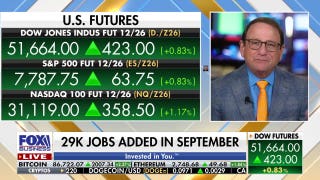
The Bureau of Labor Statistics on Friday reported that employers added 29,000 jobs in September. That figure was below the 90,000 estimate of economists polled by LSEG.

Economists expected employers to add 90,000 jobs in September. (Al Drago/Bloomberg via Getty Images)
The unemployment rate ticked higher to 4.2%, which was above economists' expectations of 4.1%, according to the LSEG poll.
Revisions were made to the payroll numbers for the prior two months, with July revised down by 31,000 from a gain of 21,000 to a loss of 10,000; while August was revised down by 29,000 from a gain of 162,000 to 133,000.
Taken together, employment in July and August is 60,000 lower than previously reported.
What sectors added or lost the most jobs in September 2026?
Private payrolls grew by 46,000 jobs in September, below the gain of 85,000 that was estimated by economists in the LSEG poll. August's gain of 127,000 private sector jobs was revised down to 89,000.
Government payrolls contracted by 17,000 jobs in September. The sector's gain of 35,000 jobs in August was revised up to a gain of 44,000. The federal government shed 1,000 jobs, while state government employment contracted by 3,000 jobs and local government employment fell by 13,000 jobs. Most of the state and local job losses were in education.
The manufacturing sector added 9,000 jobs in September, just shy of the LSEG poll's expectations of 10,000. August's gain of 16,000 jobs in the sector was revised down slightly to 15,000.
Healthcare added 17,000 jobs in September, with most of the gains in ambulatory healthcare services (+13,000) and hospitals (+12,000), while nursing and residential care facilities lost jobs (-9,000). The gain was a slower pace than the average monthly gain over the prior 12 months (+33,000).
Construction employment changed little but added 11,000 jobs last month, just above the average of 10,000 over the prior 12 months. Employment in nonresidential specialty trade contractors trended up last month with a gain of 12,000 jobs.
Financial activities were also little changed and contracted by 7,000 jobs in September. The sector is down 129,000 jobs from a recent peak in May 2025, with most of the job loss in insurance carriers and related activities (-90,000).
What does the September 2026 jobs report mean for the workforce?
The number of long-term unemployed, defined as those who have been jobless for 27 weeks or more, was essentially unchanged at 1.9 million in September. The long-term unemployed accounted for 27.1% of all unemployed people.
The number of people employed part-time for economic reasons was little changed at 4.5 million last month. These individuals would've preferred full-time employment but were working part-time because their hours had been reduced, or they were unable to find full-time jobs.
The labor force participation rate was 61.8% in September, while the employment-population ratio was 59.2%. Both figures changed little in September and have shown little net change since January.
Average hourly earnings increased 3% in September, below the 3.2% increase that was expected by economists polled by LSEG.