


What’s fueling Wall Street’s growing concerns about AI?
The Dow tumbled 1,833 points, and the Nasdaq suffered its worst day since April 2025

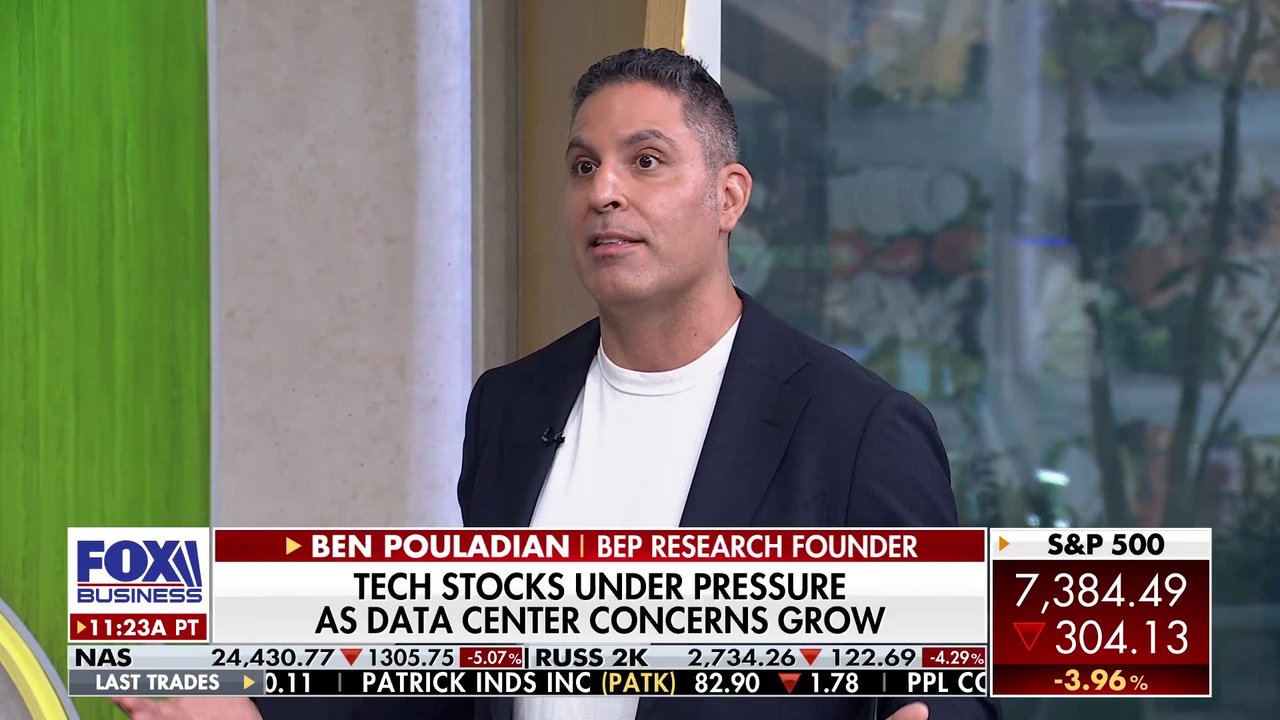
Stocks plunge as chipmakers, AI infrastructure stocks lead selloff
BEP Research founder Ben Pouladian analyzes the technology stock sell-off and concerns surrounding artificial intelligence infrastructure on ‘Making Money.’
U.S. stocks plunged Thursday as investors dumped AI stocks, but market experts say Wall Street's concerns go beyond a single bad day.
The Dow Jones Industrial Average fell 1,833 points, or 3.44%, while the Nasdaq Composite plunged 5.52% in its worst session since April 2025. The Nasdaq also closed in correction territory, at least 10% below its Oct. 6 record closing high.
Behind the rout are growing concerns about the massive spending and borrowing fueling the AI boom and whether those investments will pay off.
STOCKS PLUNGE AS DEM MIDTERM SWEEP FUELS AI REGULATORY CONCERNS
"Debt," Paul Mueller, an economist with the American Institute for Economic Research, said when asked what Wall Street is most worried about when it comes to AI.
"Wall Street is worried about the enormous amounts of debt obligations being issued by tech companies to build data centers, both because interest rates have been rising and because there is greater political uncertainty around how much opposition data center construction will face," Mueller told FOX Business.

A view of the New York Stock Exchange and surroundings in New York City Nov. 5, 2026. U.S. stocks remained volatile after the midterm elections. (Selcuk Acar/Anadolu via Getty Images)
The concerns come as tech giants pour billions into the infrastructure powering the AI boom.
Adam Patti, CEO of VistaShares, said investors are confronting three concerns at once, which are political uncertainty, return on investment and an increasingly crowded AI trade.
"The first is political: the midterm results, including wins in several key data center states, raised fears that the buildout will face more regulation, slower permitting and pushback over power bills," Patti said.
"The second is return on investment, with investors asking how long hyperscalers can keep spending at this pace while free cash flow goes negative. The third is positioning. Semiconductors were the most crowded trade in the market, and crowded trades unwind violently."
US STOCK FUTURES MIXED AS DEMOCRATS SCORE KEY MIDTERM ELECTION WINS

Traders work on the floor of the American Stock Exchange at the New York Stock Exchange in New York City on Nov. 4, 2026. (Michael Nagle/Bloomberg via Getty Images)
EToro market analyst Jakub Rochlitz said heavy borrowing and crowded trades may have made the sell-off worse.
"What the markets were missing was a spark to start the sell-off. It seems that the mix of the election result and some disappointing tech earnings results was enough to tip markets over the edge. We are likely seeing a large number of crowded and leveraged trades unwind," Rochlitz said.
Power is another concern because the massive electricity needs of AI data centers raise questions about grid capacity, utility costs and how quickly new facilities can come online.
"Power is the real bottleneck in AI today, more than chips, and it deserves investor focus," Patti said.
| Ticker | Security | Last | Change | Change % |
|---|---|---|---|---|
| I:DJI | DOW JONES AVERAGES | 51523.06 | -1,833.06 | -3.44% |
| SP500 | S&P 500 | 7353.73 | -334.89 | -4.36% |
| I:COMP | NASDAQ COMPOSITE INDEX | 24314.997303 | -1,421.52 | -5.52% |
He said much of the political risk remains at the state and local levels, while data center development could shift to areas with more available power and fewer permitting hurdles.
BUSINESS LEADERS, INVESTORS WEIGH IMPACT OF DEMOCRATS’ MIDTERM SWEEP ON MARKETS, AI AND TRAVEL
"Capacity relocates. It does not disappear," Patti said.
Despite Thursday's plunge, Patti said the sell-off does not necessarily mean AI demand has weakened.
"This is a valuation and sentiment reset, not a change in fundamentals," he said.
CLICK HERE TO GET FOX BUSINESS ON THE GO
Mueller cautioned everyday investors against reading too much into a single volatile session.
"For most people, focusing on diversification and holding investment positions for long periods of time is by far the best strategy," he said.
"And that involves doing your best to ignore market volatility."